Lodi, Seneca County · Chapter 6 Companion
The Seneca Lake Guns: Acoustic Mystery Booms and Finger Lakes Geology
Explore the documented acoustic phenomena known as the Seneca Lake Guns, nineteenth-century scientific notices, Haudenosaunee lore, and modern geological explanations.
Evidence at a Glance
- Documented history
- Explosive, cannon-like booms echoing across Seneca Lake without visible smoke or storms have been noted in historical journals, scientific notices, and government surveys since the early 1800s.
- Reported folklore
- Haudenosaunee oral tradition and early settler tales attributed the subterranean booms to ancient battle drums, angry water deities, or phantom artillery fired from sunken warships.
- Unverified
- Any supernatural, military phantom, or extraterrestrial origin. The booms are well-documented acoustic and geophysical events.
What the legend says
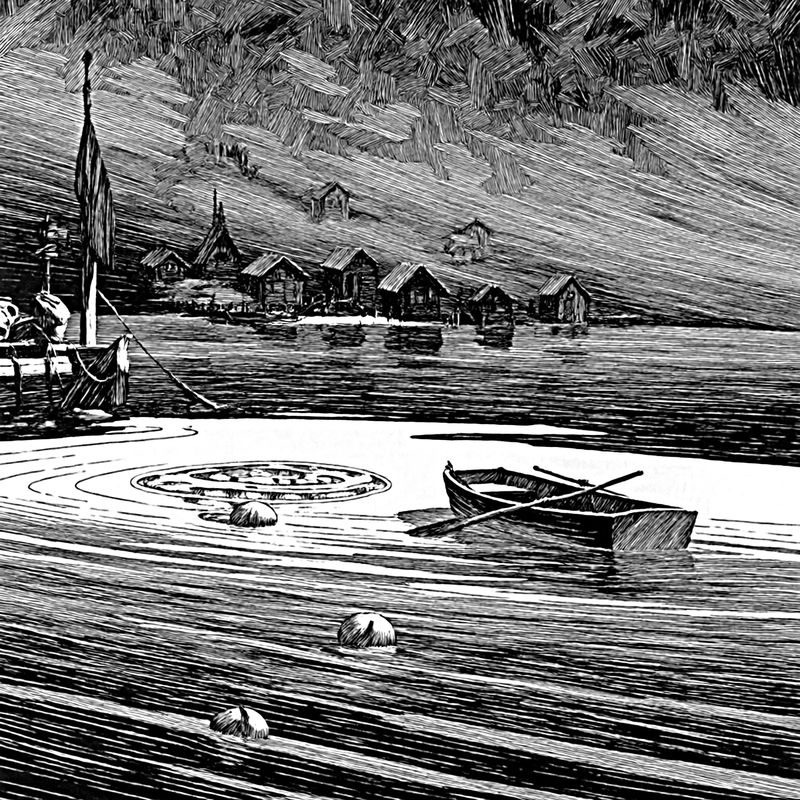
Residents and cottage owners along Seneca Lake frequently report sudden, concussive booming sounds that rattle cottage windows and vibrate through boat hulls. Known locally as the 'Seneca Lake Guns' or 'Lake Drums,' these sounds resemble distant cannonades on perfectly clear, windless days.
Earliest credible accounts
The phenomenon was famously described in print by American author James Fenimore Cooper in his 1850 short story 'The Lake Gun.' Scientific accounts appeared in the *American Journal of Science* as early as the 1880s, detailing how booms were heard from Geneva at the north end of the lake to Watkins Glen at the south.
Documented historical context
Seneca Lake is the deepest of the Finger Lakes, reaching depths of over 618 feet with a bed that drops nearly 200 feet below sea level. Similar mystery booms occur at deep water bodies worldwide, known in Belgium as *mistpoeffers*, in India as *Barisal guns*, and on Lake Michigan. Modern geologists propose two primary mechanisms: the sudden escape of pressurized methane or natural gas pockets trapped in deep lacustrine sediment layers, and thermal sound ducting, where small atmospheric disturbances miles away are acoustically channeled across the dense cold lake air inversion.
Conflicting versions
Folklore often debates whether the booms originate high in the atmosphere or from the deep mud trenches of the lake floor, with boaters frequently insisting the shock waves strike the bottoms of their hulls first.
What remains unverified
While seismic monitoring stations regularly register minor natural bedrock tremors in central New York, many reported booms do not register seismically, confirming that atmospheric ducting plays a major role in how the sound carries.
How the fiction adapts the material
Chapter 6, 'The Seneca Lake Guns,' places two young cottage caretakers in Lodi who use directional hydrophones and sound recording gear to track the booms across the water, uncovering a suspenseful underwater mystery.
Sources
- Cooper, James Fenimore. 'The Lake Gun.' Specimen Days and Collect, 1850.
- Fairchild, Herman L. 'The Geology of Seneca Lake.' New York State Geological Survey Bulletin, 1928.
- United States Geological Survey: Acoustic anomalies and seismic records in the Finger Lakes region.