Chapter 1 · Free online chapter
The Blue Lady of Hidden Lake
Churchville, Monroe County, New York · By M. E. Sutherland
Before You Read
Content notes: A girl taken from her mother long ago, learned from records; family separation; dark cellar suspense. No graphic violence.
Scare rating: 3 of 5 · Check Under the Bed — Sustained eerie atmosphere and historical mystery, balanced by humor and a safe resolution.
Reading facts: Approximately 14 minutes · About 2,800 words · Author: M. E. Sutherland · Illustrator: Dennis Francis
Sophie Brennan's mother told the story as a joke. That was the first wrong thing about the night.
"In 1918," her mother said, passing the green beans, "a woman in this town lost her mind and let her little girl drown in Hidden Lake. Now the Blue Lady walks the dock, looking for her mother. So eat your vegetables, or I'll go mad and wander the shore in my bathrobe."
She laughed. The kitchen was too quiet for one person laughing.
Sophie didn't laugh. She pushed a bean to the edge of her plate and looked at the third chair, which had been empty for twenty-three days. She knew it was twenty-three because she'd counted.
On the fridge, held up by a magnet shaped like a lemon, was a flyer. OPEN NIGHT. THURSDAY THE 14TH. FAMILIES WELCOME!
Families. Plural. Sophie wondered if a family counted as plural when it lived at two addresses.
"May I be excused?" she said.
"You may be excused to load the dishwasher."
She loaded the dishwasher. Then she went upstairs to her room and turned on the light and stopped.
There was a new mark on her map.
The map took up most of one wall. It was Churchville and everything around it, taped together from six printed sheets, and it had forty-one marks on it. Forty-one ghost sightings, every one Sophie had been able to find, each one an X in black pen with the date printed beside it in small capitals.
The new mark was blue.
It sat at the far end of the boarded dock on Hidden Lake. A small, neat X. Beside it, in tiny capitals: NOV. 4.
Today.
It was her handwriting. Her capitals. Her habit of putting a little flat hat on the top of the 4.
Sophie didn't own a blue pen.
She stood very still in the doorway and made a list in her head, because that was what she did when the floor felt tilted.
1. The map was hers. 2. She hadn't drawn the mark. 3. The only person who'd been in her room all week was Wynn Halloran.
Number three was the only one that made sense. Sophie held on to it with both hands.
* * *
"I didn't touch your map," Wynn said.
"You were in my room Sunday."
"Because we got assigned partners. Against my will. I was in your room for forty minutes and I spent thirty of them looking at your ghost wall and trying not to laugh." Wynn shut her locker. "Why would I draw on it? It's already ridiculous."
Wynn Halloran was the only other person in the seventh grade who cared about ghosts, which should have made them friends. Instead she ran a page called Haunted Churchville, where she posted shaky videos of herself whispering in parking lots, and Sophie ran a map with dates on it, and they each believed the other one was doing it wrong.
"It's in my handwriting," Sophie said.
"So you drew it and forgot. People do that. My dad once forgot he owned a boat."
Sophie looked at Wynn's face for a long time. Wynn looked back, bored.
Sophie half believed her. She didn't like that at all.
The project was called Churchville Then and Now. It was due at Open Night, which meant ten days of working with Wynn, which meant ten days of Sophie's life she would never get back.
After school they went to the library, because the town historian kept her office in the back of it.
A historian, Sophie had learned in fourth grade, was a person whose whole job was remembering things for everybody else. Churchville's historian was Mrs. Dalrymple, who had white hair cut very short and reading glasses on a beaded chain, and who looked at kids the way a cat looks at a dropped sandwich. Interested, but not about to get up.
"The Hidden Lake story," Mrs. Dalrymple said. "Everybody wants that one."
She opened a huge green book on her desk. The pages were thick and soft from being turned. Sophie saw dates down the margins, hundreds of them, in a dozen different hands.
"This is the town record," Mrs. Dalrymple said. "It goes back a long way. My job is to keep it." She turned to a page near the front and tapped an entry with one finger. "1918. A mother on Main Street. The child lost in the lake. And see this?"
Next to the entry, in old brown ink, were two words: *as told.*
"That means nobody had papers," Mrs. Dalrymple said. "No proof. Just the story the town told itself. It goes in my book as told, and it stays as told, unless somebody brings me something better."
"Has anybody?" Sophie said.
"Not in over a hundred years." Mrs. Dalrymple took off her glasses. "Main Street was all boarding houses then, you know. Rooms rented by the week, to men coming through town for work. Most of those houses are gone. The old hardware store sits on top of one of them." She sniffed. "The cellar under that store has been shut since the flood. Smells like a wet dog's opinion."
Wynn snorted. Sophie wrote *as told* in her notebook, and *boarding houses*, and *cellar, shut since the flood.* She underlined the last one without knowing why.
On the library steps, Wynn held up her phone.
"I'm filming at the dock tonight," she said. "Dusk. For the page. You stand at the end of the dock and I tell the story, and we see if the Blue Lady shows up." She smiled. "Unless you're scared. Which, based on the wall, you are."
"I'm not scared," Sophie said. "I'm accurate."
"So that's a yes."
It was a yes.
* * *
Hidden Lake was small and black and sat in a bowl of bare trees on the north edge of town. In summer people fished it. In November nobody went there at all, which Sophie now understood was a policy for a reason.
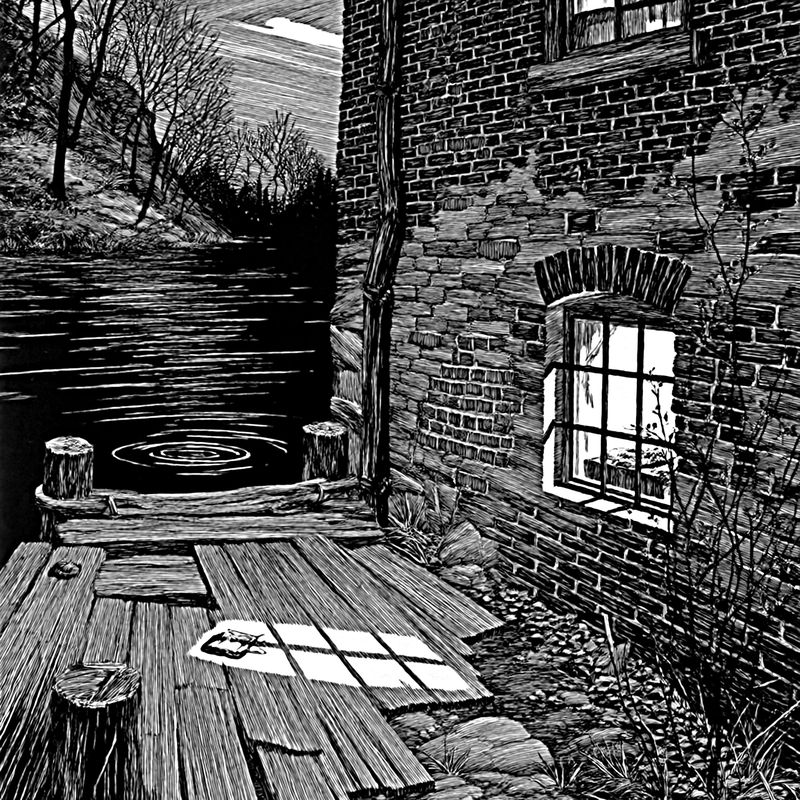
The dock had been boarded off years ago. A sign on the boards said NO ACCESS, and someone had added, in marker, AND NO EXITS EITHER. Wynn climbed over. Sophie climbed over after her.
The boards were slick. The wind pushed little waves against the posts, and every few seconds a cold spray came up through the cracks and soaked Sophie's sneakers.
"Stand at the end," Wynn said. She held up the phone. Its small light made the dark around them darker.
Sophie walked to the end of the dock. Her socks squelched.
Wynn cleared her throat and put on her whispering voice.
"In 1918," she said, "a woman in this town lost her mind and let her little girl drown in Hidden Lake..."
Something hummed out over the water.
It was low and even, one note, like a person humming with their mouth closed while they did the dishes. It didn't come from anywhere. It came from the whole lake.
The zipper on Sophie's jacket started to buzz against her chest.
Wynn stopped talking.
There was a girl standing on the dock.
She was maybe ten. She wore a blue dress that went to her ankles, and her hair hung straight and dark, and she was standing three boards away from Sophie, where nobody had been standing a second ago.
Spray came up through the boards around her feet.
The boards went dark with it.
The hem of the blue dress stayed perfectly dry.
Sophie's sneakers were soaked through. She could feel the lake water between her toes. And the girl's hem, right there in the same spray, was dry as a folded towel.
The girl was looking at Sophie's hands.
Not her face. Her hands. Sophie realized she was holding her pen, the black one, the way she always held it when she was about to mark something down.
The girl turned and stepped off the end of the dock.
She didn't fall. She didn't splash. She stepped down onto the black water and walked away across it, and the waves slapped at her ankles, and her hem stayed dry the whole way.
The humming stopped.
Wynn's phone hit the boards.
* * *
They ran until the road. Then they bent over with their hands on their knees and breathed like two broken accordions.
"Did you get it?" Sophie said. "On video?"
Wynn checked the phone. Her face did something complicated.
"I got forty seconds of the sky," she said, "and me making a noise I didn't know I could make."
She played it. It was mostly a shriek. Sophie laughed so hard she had to sit down on the gravel, and then she wasn't sure she was laughing anymore, and then she was again.
"That's not even the one who drowned," Wynn said, when they could talk. "Did you know that? A different girl drowned at the old boathouse, down the shore. In 1927. Nobody remembers her. She doesn't even have a story." Wynn pulled her hood up. "The blue one is supposed to be 1918. That's what everybody says."
Sophie looked back at the lake. It sat in its bowl of trees and said nothing.
* * *
Sophie checked her map before school. She'd been too wound up to look the night before.
There was a new blue mark. NOV. 5. At the shore end of the boarded dock, where the boards met the land. A few steps closer than the first one.
Sophie didn't like how close together the two marks were. She decided not to think about it until after lunch.
By lunch, the whole school had heard about the dock. Wynn hadn't posted the video, because the video was a scream. But Wynn had told two people what happened, and those two had told everybody, and now the cafeteria wanted the story.
A boy Sophie didn't know climbed up on the bench at the next table and told it to the whole room, holding a chicken nugget like a microphone.
"She drowned her," he said at the end. "Her own kid. Because she was crazy."
"In a blue dress," someone yelled.
"The mom or the kid?"
"Both, probably."
Sophie ate her apple and didn't say anything. She had a feeling in her stomach she couldn't put on a list.
That night there was a new mark on her map.
Blue. Her handwriting. NOV. 6.
It wasn't at the dock. It was on the old road that ran from the lake toward town, about a third of the way in.
Sophie got out a ruler. She measured it twice. Then she wrote on a sticky note, *Tuesday: Wynn told the story. Wednesday: the cafeteria told the story. Both nights: she came closer.* She stuck the note to the edge of the map and looked at it until her eyes hurt.
* * *
On Thursday the whole seventh grade stayed after school to start building their Open Night displays.
The art room smelled like glue sticks and somebody's orange. By the time Sophie had cut out her third map, the windows were going blue. November dark came early, like it had somewhere better to be.
She looked up.
There was a blue shape at the school fence.
It stood by the far corner, near the bike rack, small and still. A girl in a long blue dress, facing the school.
"She's here," Sophie said. She stood up so fast her chair went over. "She's at the fence. Look. Look!"
Twenty-six people turned to the window.
The fence was empty.
Someone started laughing. Then everyone was, the big rolling kind that goes around a room twice. Someone did a ghost noise. The teacher said, "All right, all right," in the voice that meant he was laughing too, just quietly.
Across the room, Wynn Halloran had her head down over her poster and was gluing a picture of a covered bridge very carefully.
Sophie picked up her chair. Her face was hot enough to cook on.
Her father was supposed to pick her up at six for dinner at the diner. He came at seven. He said sorry three times, which was two more than usual, and at the diner he ordered for both of them without asking, and he got hers right.
"Your mom and I used to scare each other with that Hidden Lake story," he said, while they waited. "When we were dating. You know it? 1918, crazy mother, drowns her kid..." He wiggled his fingers. "Ooooh."
"Dad. Please don't."
"What? It's a classic."
That night the new mark was at the edge of town, where the old road turned into Main Street.
NOV. 7.
Sophie sat on her bed and wrote a list on the back of her hand in pen.
1. Mom told it. Dock. 2. Wynn told it. Shore. 3. The cafeteria told it. Old road. 4. Dad told it. Main Street.
Every time somebody told the story, the girl came closer.
* * *
The Saturday library was quiet and warm and smelled like old radiators.
Mrs. Dalrymple let them into the archive, which turned out to be a long closet with a fan in it and boxes up to the ceiling, every box labeled in the same square handwriting. An archive, Sophie decided, was what you called a closet when the things in it were too important to throw away.
Wynn insisted on being useful. She insisted on it loudly.
"Here's one," she said. "Main Street fire. 1812."
"That says 1912."
"Same century."
"It's not the same century. That's what a century is."
"Here's a flood. 1846."
"That's a page number, Wynn."
"Then why is it so big?"
Sophie laughed before she could stop herself. Wynn looked pleased, and then annoyed that she looked pleased.
It was Wynn who found the clipping. A strip of yellow newspaper folded inside a folder marked MAIN ST. MISC. It was from 1917, and it was an ad. ROOMS BY THE WEEK. CLEAN BEDS. GOOD TABLE. INQUIRE WHITMORE HOUSE, 14 MAIN ST.
"Fourteen Main," Sophie said. She knew that number. It was painted in gold on the glass door of the hardware store, at the corner of Main and her own street. She walked past it every day.
Wynn didn't answer. She was looking at her backpack.
"I have to tell you something," she said. "And you have to not do the face."
"What face?"
"The face you're already doing."
Wynn unzipped the backpack and pulled out a bedsheet. It was blue. It was soaked, and gray-brown along the bottom with mud, and it smelled exactly like the edge of Hidden Lake.
"The fence," Wynn said. "Thursday. That was me. I wore it over my head and stood by the bike rack, and then I ran around the gym and came in the side door. I dragged it through the lake first, so it would look like..." She trailed off. "Drowned. For the page. I didn't think you'd yell. I thought you'd just look scared and I'd film it."
Sophie stared at the sheet. Her face was doing the face.
"And the map?" she said. "The blue marks?"
"That wasn't me. I swear on my phone."
Sophie took a pen out of her pocket and held it out. "Write NOV. 4."
Wynn wrote it on the back of the clipping folder. Her letters were big and loopy, and the 4 had no little hat on it at all.
It wasn't Wynn.
Sophie told her about the marks, then. All of them. The dock, the shore, the old road, Main Street. Mom, Wynn, the cafeteria, Dad. Wynn listened without interrupting, which had never happened before in recorded history.
"Oh no," Wynn said slowly. "I told it this morning. Again. For a new video. I said the whole thing into my phone, out loud, start to finish."
Sophie went home and up the stairs two at a time.
The new mark was on Sophie's own street.
NOV. 9.
At the bottom of her street, where it met Main. Four houses down from hers.
* * *
On Sunday the sun went down at a quarter to five.
Sophie stood at her bedroom window with the map behind her and watched the street go gray.
At the bottom of the street, where it met Main, under the streetlight that hadn't come on yet, stood a girl in a blue dress.
She wasn't moving. She was just there. Facing up the street, toward Sophie's house.
It had rained all afternoon. The sidewalk was shining wet, and the gutters were running, and puddles stood along the curb.
The hem of the blue dress was perfectly dry.
Sophie thought of the bedsheet in Wynn's backpack. Soaked through. Muddy. Smelling of the lake, because it had been in the lake.
And the dress at the dock, in all that spray, dry as a towel.
The dress was dry because it had never been in the lake.
The girl had never gone into the water at all.
Sophie turned around and looked at her map. She looked at it the way you look at a word you've written so many times it stops looking like a word.
Then she took a ruler and laid it across the blue marks, in the order of their dates. NOV. 4, the dock. NOV. 5, the shore. NOV. 6, the old road. NOV. 7, the edge of Main. NOV. 9, her street.
They made a line. One straight line, from the dock up the old road and into town.
And the line ran right through the corner where her street met Main.
The hardware store.
The girl hadn't been coming for Sophie. Or not only for Sophie. She'd been drawing an arrow. She'd been watching Sophie make marks on a map for weeks, and she had learned how, and she'd used Sophie's own handwriting to point.
When Sophie looked back out the window, the bottom of the street was empty.
* * *
The hardware store closed at five on weekdays. On Monday at four-fifteen, Sophie and Wynn walked around to the side of it, where a narrow alley ran between the store and a dentist's office.
Sophie had told Wynn about the line at lunch. Wynn said it was unhinged, then asked what time.
Down at the bottom of the brick wall, half hidden by a dead bush, was a small window with an iron grate over it. The cellar window. One corner of the grate was rusted almost through. Somebody bigger than Sophie couldn't have fit. Somebody exactly Sophie's size probably could.
Sophie crouched and shone her phone light inside. It lit up the edge of one old shelf and gave up. The cellar smelled like a wet dog's opinion.
"Your light is pathetic," Wynn said. "Move."
She knelt in the dead leaves, pushed her phone between the bars and zoomed all the way in. The flash lit the cellar white for half a second.
They bent over the phone with their heads touching.
In the photo, the cellar was low and full of old shelves. Three of the walls were dry, pale brick, dusty and ordinary.
The fourth wall was dark.
It was sweating. Water stood on the bricks in beads, and ran down them in thin lines, the way a cold glass sweats on a hot day. Except it was November, and the other three walls were bone dry.
Wynn spread two fingers on the screen. In the middle of the wet wall, level with the second shelf, was a small square of bricks a slightly different color from the rest. Newer. Crooked, as if somebody had laid them in a hurry.
"Say, 'Wynn, you're a genius,'" Wynn said.
"You pushed a button."
"I pushed it brilliantly." Wynn looked enormously pleased with herself. "I'm sending it to you. My name goes in the credits."
Sophie opened her mouth to say there weren't any credits. She shut it again. It was a good photo.
Then, from somewhere inside the cellar, came a hum.
It was lower than the one on the lake. Older. Slower. Like a grown woman humming.
Sophie had one hand on the grate. The iron bars buzzed against her palm.
And far off, from the direction of the lake, so faint Sophie almost thought she'd made it up, the higher hum answered.
Neither of them said anything. Sophie had to remind herself to breathe.
They didn't go in. Not yet. First Sophie went back to the library, because something was bothering her, and she had learned that the things that bothered her were usually trying to tell her something.
"1927," she said to Mrs. Dalrymple. "Is there anything in the book? About the boathouse?"
Mrs. Dalrymple gave her a long look over the beaded chain. Then she turned the thick pages.
There it was. 1927. A girl, the boathouse at Hidden Lake. Lost. And beside it in faded blue ink: *as told.*
A different story. A different girl. No papers.
"Huh," said Mrs. Dalrymple quietly, like someone who had read that line a thousand times and just now noticed it.
* * *
On Tuesday, Sophie left a note on Mrs. Dalrymple's desk at three-thirty, folded once, under the stapler where it couldn't blow away.
*The marks run to the Main Street cellar. One wall sweats. I'm going at dusk. Bring a lamp. S.*
Then she went home and got her father's headlamp out of the hall closet, the one he'd left behind, the one he used to wear to fix the furnace while saying words Sophie wasn't supposed to know. She put it on. She looked like a very small coal miner. She did not care.
Wynn couldn't come. Her mother had found the blue sheet, and Wynn was scrubbing lake mud out of the washing machine with a toothbrush. She texted Sophie a photo of the mud, which was less helpful than her last one.
By four-thirty the light was closing down over Churchville like a lid.
Sophie walked down her street toward Main.
She was halfway down when she saw the girl.
The girl in blue stood at the foot of the street, under the streetlight, right where she'd stood on Sunday. Nobody had told the story since. Sophie walked down toward her until she was close enough to see the dress had little white buttons down the front, and one was missing.
Behind her, somewhere on Main Street, a car went by with its radio on, playing something happy.
The girl was looking at Sophie's hands again.
Sophie's legs wanted very badly to go back up the street. She made a list instead.
1. She hasn't hurt anybody. 2. She drew an arrow. 3. The arrow points that way.
She walked past the girl without looking at her face, the way you walk past a dog you're not sure about. The air went cold on that side of her body, cold like an open freezer. The hum started up, close enough now to feel in her teeth.
She turned into the alley and got down on her knees by the grate.
The rusted corner bent when she pushed it. It scraped her wrist. She went in feet first, on her stomach, and dropped onto a cellar floor that was gritty and cold and further down than it looked.
The headlamp made a small yellow circle. Everything outside the circle was black.
The sweating wall was in front of her. Sophie went straight to the patch, chest high, beside the second shelf. She'd stared at Wynn's photo half the night. The mortar between the newer bricks was soft and crumbled when she dug her fingernail in.
She started pulling.
The first brick came out after a long time. The second came faster. The water on them was so cold it made her fingers ache, and then stop aching, and then stop feeling like fingers at all. She worked them like clumsy wooden spoons.
The lower hum filled the cellar. It came out of the wall in front of her. Her zipper buzzed against her chest, slower than on the dock.
From outside, from the street, the higher hum came closer.
The headlamp flickered.
Sophie said a word her father used on the furnace.
The light went yellow, then orange, then a dim brown glow like a coal in a dead campfire. She pulled the fourth brick by feel. Her hand went into the hole up to the wrist, into cold air, and touched metal.
A box. Small and square and rough with rust.
She pulled it out and held it against her chest.
The window above her went dark. Something was blocking the grate.
Sophie looked up into a light. A real one, white and steady, a camping lantern held low at the bars.
"I assume," said Mrs. Dalrymple, from the alley, "that you are S."
Sophie made a noise that was half a laugh and half something else.
"I'm not coming in there," Mrs. Dalrymple said. "My knees retired in 2009. Hand it up."
Sophie stood on an old crate and handed the tin box up through the bent corner of the grate. Then she climbed out after it, scraping her other wrist, and sat in the alley in the lantern light while her fingers came back, painfully, one at a time.
The street at the end of the alley was empty.
Inside the box, wrapped in oilcloth, were two pieces of paper.
The first was a page torn from a ledger. At the top, in curly printed letters: FUNERAL DIRECTOR. CHURCHVILLE, N.Y. A funeral director was the person who took care of people after they died. Sophie's grandpa's had worn a bow tie and spoken very softly. This one had written in a cramped, nervous hand.
*Rec'd of H. Crane, boarder at Whitmore House, ten dollars, to enter the Whitmore girl as drowned. No body was found. Crane gone from town the same night. God forgive me. I will not say it out loud.*
The second was a letter, folded small.
*My girl did not go into the lake. She was taken by the man who owed us rent. I have kept this page where the town clerk's family will not find it, for they have no wish to. They call me mad. Let them. Someday someone will listen.*
It was signed *her mother.*
Mrs. Dalrymple read both of them twice. Then she turned off the lantern and sat on the alley step beside Sophie in the dark for a while, not saying anything, which Sophie decided was the most respectful thing she'd ever seen an adult do.
* * *
Mrs. Dalrymple wrote it into the town record the next morning. Sophie watched her do it.
She didn't cross out the old entry. She wrote underneath it, in her square, careful hand, with the date. The funeral director's page. The mother's letter. The words *not drowned. Taken.* And at the end, where the old entry said *as told*, the new one said *as documented.*
That evening Sophie and Wynn walked to Hidden Lake at dusk. They didn't climb over the boards. They stood on the shore.
The higher hum came first, from out on the water. Then the lower one, from the direction of town, moving closer along the old road.
The two hums met at the edge of the lake.
For a moment they were the same note.
Sophie's zipper, which had buzzed since the higher hum began, went still.
Then they stopped, both together, and the lake was just a lake.
Wynn didn't film it. Sophie noticed that.
* * *
Open Night was loud and bright and smelled like coffee in paper cups.
Churchville Then and Now got a blue ribbon, which Wynn said was ironic, and Sophie said was not what ironic meant, and they argued about it happily for ten minutes.
Both of Sophie's parents came.
They sat apart, three folding chairs between them. Her father brought a bag of peanut butter cups. He handed it to Sophie, then seemed to notice what was in it, and his ears went red. Peanut butter cups were her mother's favorite. Sophie liked the gummy ones.
Her mother looked at the bag and then at the floor and smiled a little, the sad kind.
They didn't get back together. Sophie hadn't really thought they would. But on the way out, her father held the door, and her mother said thanks, and nobody made a joke about anything.
Sophie made a list in her head on the drive home.
1. Some things stay broken. 2. Some things were never what everybody said. 3. You can tell which is which if you write down the dates.
* * *
She went up to her room and turned on the light.
The map was where it always was. Forty-one black marks. Five blue ones, already fading, the line from the lake to the hardware store.
And one more.
Blue. Small and neat. Down on the shore of Hidden Lake, at the old boathouse.
The ink was still wet.
Beside it, in Sophie's own small capitals:
1927.
Continue the New York Collection
This free chapter is the opening story in Hometown Horror Stories: New York, alongside nine more tales inspired by New York places and regional folklore.
View the New York Book on Amazon