Upper Nyack, Rockland County · Chapter 7 Companion
The Phantom Storm Ship: Maritime Lore of the Tappan Zee and Hook Mountain
Discover the maritime legend of the Flying Dutchman of the Tappan Zee, colonial Dutch sightings off Hook Mountain, and the river conditions that inspired ghost ship lore.
Evidence at a Glance
- Documented history
- The Tappan Zee is the widest stretch of the Hudson River (approaching 3 miles). Colonial sloop logs from the 1600s and 1700s document treacherous river fogs, shifting winds, and optical mirages.
- Reported folklore
- For over three centuries, river sailors have whispered of a phantom Dutch sloop that glides silently upstream against both tidal currents and gale winds near Point No Point.
- Unverified
- A physical ghostly ship or spectral crew. Optical refraction (fata morgana) and low-lying river fog explain sightings of floating or disembodied masts.
What the legend says
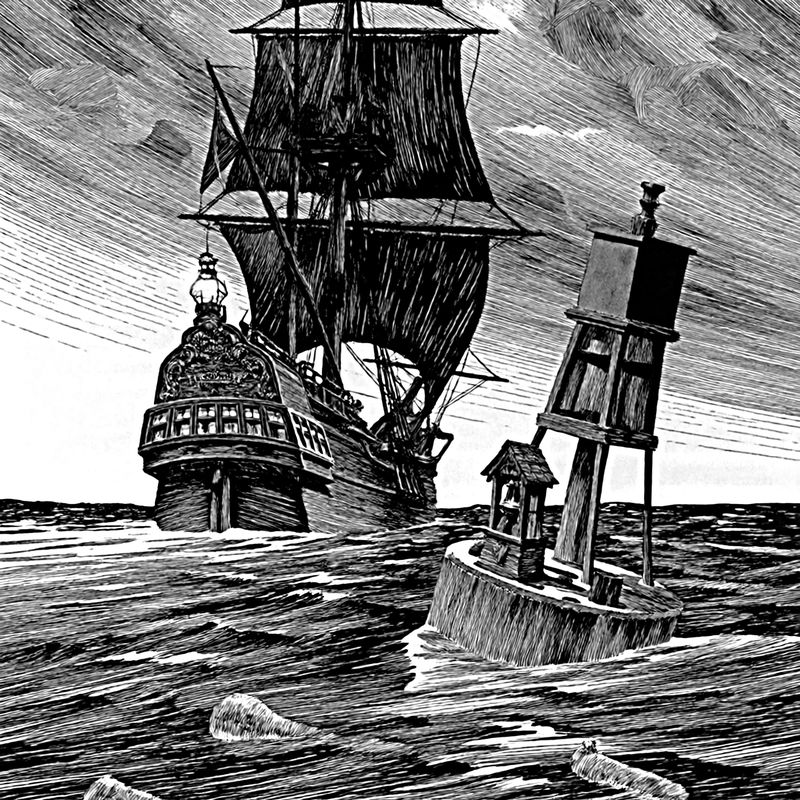
Hudson River folklore tells of a spectral Dutch merchant vessel with billowing white sails that glides northward through the Tappan Zee without leaving a wake. Defying wind and current, the 'Storm Ship of Point No Point' appears suddenly in heavy twilight fog off Upper Nyack and Hook Mountain, disappearing into thin air just as other vessels swerve to avoid collision.
Earliest credible accounts
The legend dates back to seventeenth-century New Netherland Dutch skippers. It was recorded by Washington Irving in 'The Storm-Ship' (1822) and chronicled by Charles M. Skinner in *Myths and Legends of Our Own Land* (1896).
Documented historical context
The Tappan Zee is prone to dramatic temperature inversions, where warm air passes over colder tidal waters, creating dense radiation fog. These meteorological conditions produce complex optical mirages (superior mirages), in which distant sloops or rivercraft beyond the horizon appear projected into mid-air, inverted, or magnified above the waterline, startling onlookers on the Nyack bluffs.
Conflicting versions
Variations of the legend identify the ship with a lost crew from Amsterdam, while others claim it is a phantom vessel carrying the storm spirits of the Palisades.
What remains unverified
No vessel wreckage or historical registry has ever proven the loss of a specific 'curse ship' in the Tappan Zee; the story represents the classic maritime ghost ship tradition adapted to American tidal river geography.
How the fiction adapts the material
In Chapter 7, 'The Phantom Storm Ship,' young sailor Sully Kruk is navigating his small catboat *Wren* through sudden river fog off Upper Nyack when a taut towline emerges from the mist, drawing him into an eerie encounter with Hudson River history.
Sources
- Irving, Washington. 'The Storm-Ship.' In Bracebridge Hall, New York: 1822.
- Skinner, Charles M. Myths and Legends of Our Own Land. Philadelphia: J. B. Lippincott, 1896.
- Historical Society of the Nyacks: Maritime navigation and boatbuilding archives of the Hudson River.