Pennsylvania lumberwoods folklore companion
The Squonk of Pennsylvania
Pennsylvania’s hemlock forests
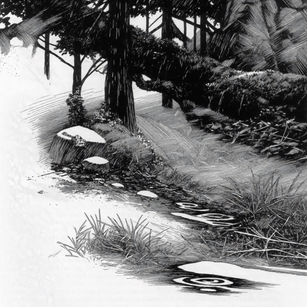
A hidden animal cries through the twilight, leaves a wet trail, and escapes capture by dissolving into tears. The Squonk’s best early text reads like a natural-history entry written with a logger’s straight face.
Evidence labels used here
Primary folklore text describes what a published tale says. Historical context explains the lumber-camp storytelling tradition. Neither label treats the Squonk as a zoological animal.
What the legend says
William T. Cox’s 1910 Fearsome Creatures of the Lumberwoods, with a Few Desert and Mountain Beasts places the Squonk in Pennsylvania’s hemlock forests. The animal is said to travel around twilight, ashamed of loose, blemished skin and crying continually. Hunters can follow its tear-wet path. Moonlight and cold weather supposedly make the creature easier to catch.
Cox gives the capture to a man named J. P. Wentling. After luring the Squonk into a sack, Wentling carries it home and feels the burden grow lighter. The crying becomes bubbling; when he opens the sack, only liquid and bubbles remain. The mock scientific name Lacrimacorpus dissolvens turns the punch line into a specimen label: a tear-bodied thing that dissolves.
Earliest credible accounts
The earliest published Squonk account located for this review is Cox’s 1910 book. Google Books provides a digitized copy from the University of Wisconsin–Madison, and Wikisource provides a searchable transcription alongside page scans. Cox did not present field notes proving an animal existed. He collected and literary-shaped “fearsome creature” tales associated with North American logging culture.
Calling the 1910 text the earliest source reviewed is narrower and safer than calling it the moment the legend began. Stories may circulate orally before publication, and Cox’s introduction says lumber-camp yarns traveled between regions and changed in the telling. Without an earlier dated Squonk record, the oral history before 1910 remains uncertain.
Documented historical context
Fearsome critters belong to the storytelling world of lumber camps. Cox opens his collection by describing loggers as imaginative narrators who carried tales from camp to camp, strengthening and improving them along the way. The creatures parody dangers, accidents, unfamiliar landscapes, and the exaggerated expertise of the veteran woodsman.
The Squonk fits that pattern particularly well. It is pursued with hunter’s lore, assigned a habitat, given seasonal behavior, and finished with a transformation no naturalist could preserve. Coert Du Bois’s illustration supplies a memorable animal form, but the text’s comedy depends on failure: the perfect captured specimen cannot reach home because it becomes the evidence of its own tears.
Cox associates the creature broadly with Pennsylvania’s hemlock forests. He does not name Cross Fork. Cross Fork is a historic lumber-country community in Potter County and an atmospheric setting for the book’s fiction, but it is not documented as the Squonk’s origin in the 1910 source reviewed here.
Conflicting versions
Later art often makes the Squonk piglike, molelike, doglike, or wholly unclassifiable. Some versions preserve Cox’s warts and ill-fitting skin; others soften the creature into a shy, sympathetic animal. The method of escape changes too. It may dissolve from fright, embarrassment, capture, or simply uncontrollable sadness.
The location also expands. Cox says Pennsylvania hemlock forest, while modern retellings attach the Squonk to particular towns, trails, festivals, or the state as a whole. Those local connections can show how a community adopts folklore, but they should not be backdated into the 1910 passage without evidence. The name J. P. Wentling appears in Cox’s anecdote as the successful hunter, yet the text does not provide independent biographical evidence for him.
What remains unverified
No physical specimen, zoological record, or documented encounter verifies the Squonk as an animal. The source does not establish where or by whom the tale was first told, whether Wentling was a historical informant, or which Pennsylvania camp supplied the story. Its mock Latin name is part of the joke, not a scientific classification.
It is also unverified that Cross Fork played a role in the legend before the modern fictional adaptation. The honest connection is regional: both the town and Cox’s creature evoke Pennsylvania hemlock and lumber country.
How the fiction adapts the material
Chapter 5 of Hometown Horror Stories: Pennsylvania, “Whatever You Do Don’t Follow the Crying,” is original fiction set in Cross Fork. It borrows the Squonk’s crying, wet trail, forest habitat, and dissolving escape, then invents its child characters, family grief, voice mimicry, pursuit, and ravine danger.
The chapter uses crying as both warning and temptation: a sound that might belong to someone who needs help, someone who has been lost, or a creature using sorrow as a lure. That emotional plot is not found in Cox’s brief comic entry. Cross Fork was selected for atmosphere and is not documented as the legend’s specific birthplace.
Sources
- William T. Cox, Fearsome Creatures of the Lumberwoods (1910), Google Books, a digitized copy that places the Squonk in Pennsylvania’s hemlock forests.
- Wikisource scan and transcription: “The Squonk”, the proofread public-domain page containing Cox’s complete Squonk entry.
- Wikisource: complete 1910 book and introduction, describing how lumber-camp stories traveled and changed.
- University of Pennsylvania Online Books Page: William T. Cox, bibliographic access to the 1910 volume.