Schuylkill County mining history
The Sheppton Mine Disaster, Rescue, and Reported Visions
The 1963 Sheppton collapse produced a genuine rescue breakthrough and a lasting tragedy. Two miners survived almost two weeks underground; a third was never recovered. Their accounts of lights, figures, and other experiences belong to the historical record, but they are not proof of a supernatural event.
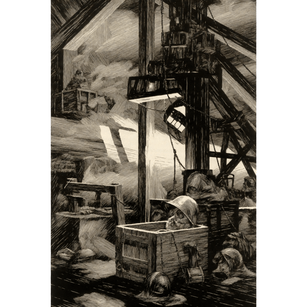
People before legend
Rescued: David Fellin and Henry “Hank” Throne. Lost: Louis Bova, whose body was never recovered. Any discussion of later lore should preserve the miners’ names and the human cost of the collapse.
What the legend says
Sheppton lore centers on unusual experiences reported during entrapment: lights in the darkness, human figures, doors, a sense of rain, voices, and religious imagery. Later retellings sometimes call these shared visions or a miracle and sometimes treat them as evidence of another realm beneath the mountain.
The dramatic rescue is not folklore. The visions are documented as survivor reports. What caused them remains a matter of interpretation, especially given darkness, isolation, hunger, thirst, stress, possible poor air, and the difficulty of comparing recollections formed under extreme conditions.
Earliest credible accounts
On August 13, 1963, a cave-in trapped David Fellin, Henry Throne, and Louis Bova in a coal operation near Sheppton. Fellin and Throne were located through drilled boreholes and brought to the surface on August 27 after nearly two weeks roughly 320 feet underground. A Pennsylvania historical marker records the rescue and notes that the borehole method influenced later mine-rescue work.
Throne gave an Associated Press account published immediately after the rescue. It included strange sights and sensations underground. Contemporary coverage therefore establishes that unusual experiences were not a recent invention, but reportage of a person’s experience still differs from independent verification of its cause.
Documented historical context
Rescuers drilled narrow holes to locate and sustain the trapped men, then widened a shaft enough to lower a rescue capsule. The effort drew national attention and demonstrated a method with implications beyond Sheppton. Pennsylvania’s 1963 mine report and contemporary public records place the event within the state’s longer struggle with mine safety.
Louis Bova was separated from the other two men. Reports of contact with him were disputed, and attempts to reach him failed. Louis Bova was never recovered. That unresolved loss is part of the event’s history and should not be reduced to atmosphere for a ghost story.
Conflicting versions
Retellings differ over what the survivors saw, whether their experiences matched, and how literally to interpret them. Some emphasize holy figures or a passage into a beautiful place. Others describe fragmented hallucinations and point to differences between the men’s accounts. Contemporary journalism itself used both miraculous and medical language.
There is also disagreement over reported communication with Bova. Officials challenged some claims, and no recovery supplied a definitive answer. An honest account leaves those limits visible.
What remains unverified
The reported visions are not proof of ghosts, angels, an underground civilization, or a passage to another world. They are meaningful testimony from people who endured extraordinary conditions. Medical or psychological explanations are plausible, but the surviving record does not permit a retrospective diagnosis with certainty. Claims about Bova’s final location or experience likewise remain unresolved.
How the fiction adapts the material
Chapter 8, “The Staircase Under the Mountain,” borrows the Sheppton setting and the motif of impossible sights underground. It invents children, a staircase, a featureless miner, and the story’s danger and resolution. Those events are fiction and should not be read as an account of Fellin, Throne, or Bova.
Sources
- East Union Township, “Sheppton Mine Disaster”, local history with contemporary reporting and Throne’s account.
- Sheppton Mine Disaster historical marker transcription, recording the rescue date, depth, and significance.
- Penn State University Libraries, Pennsylvania annual mine reports, including the 1963 state report.
- Congressional Record, August 27, 1963, contemporary rescue and safety coverage.
- Skeptical Inquirer, investigation of the reported visions, a later critical comparison of the accounts.