Pennsylvania history and folklore
The Centralia Mine Fire
Centralia, Columbia County, Pennsylvania
Centralia does not need an invented curse to be unsettling. A fire has burned through abandoned coal workings beneath the area since 1962, changing the land and displacing most residents.
Safety note
The Pennsylvania Department of Environmental Protection warns of toxic gases, hot ground, and sudden collapse. This article is historical context, not an invitation to enter restricted or unstable areas.
What the legend says
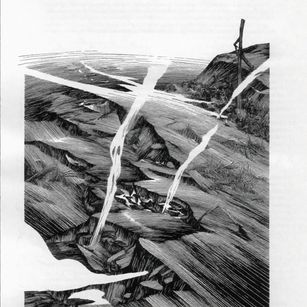
In popular retellings, Centralia becomes a vanished town above an endless underground inferno: smoke curls from cracks, roads split without warning, and empty streets conceal voices or figures. Those images borrow their force from a real industrial disaster, but ghost stories and fictional encounters are additions rather than official findings.
The reality is already extraordinary. Fire moved into abandoned anthracite mine workings, resisted repeated control attempts, created dangerous conditions, and contributed to a state relocation program. The near-empty borough then became a canvas for stories about haunted houses, cursed ground, secret tunnels, and a town erased from the map.
Earliest credible accounts
The Pennsylvania Department of Environmental Protection dates the fire to May 1962. The most widely accepted explanation is that burning municipal waste in an abandoned strip pit ignited material connected to the mine workings. DEP also notes that more than one origin theory exists. That distinction is important: an official summary can identify the leading explanation without pretending every step is conclusively settled.
Government investigations, boreholes, temperature readings, engineering projects, and relocation records provide a long documentary trail. These records are evidence of an active mine fire and public hazard, not evidence for paranormal claims.
Documented historical context
Centralia sits in Pennsylvania’s anthracite region, where generations of mining left a complex network of underground workings. Once fire entered that network, access and containment became difficult. Control efforts included excavation, water and clay, trenches, flushing, and sealing. DEP reports that thousands of boreholes have been used to investigate and monitor conditions.
By the early 1980s, danger from gases, heat, and unstable ground drove federal and state action. Most properties were acquired and residents relocated, although a small number remained under later agreements. Monitoring continues. Estimates that the fire could burn for many decades describe available fuel and difficult access; they are projections, not a supernatural claim that it can never end.
Conflicting versions
Accounts differ most sharply over the exact ignition sequence. The municipal-waste explanation is widely accepted, but alternate theories have circulated. Popular media also compress decades of policy and relocation into a single dramatic moment, sometimes implying that every resident disappeared at once or that the entire surface constantly smokes.
Visual details change with conditions and location. A photograph of steam or smoke from one period does not describe every street today. Likewise, a notorious damaged highway segment became a symbol of Centralia, but it is not a complete picture of the mine fire or of the people who lived there.
What remains unverified
The available official record does not establish ghosts, underground voices, monsters, or a curse. It cannot predict every future path of the fire or precisely measure all coal consumed. The exact ignition sequence remains less certain than the fire’s continuing existence and hazards.
How the fiction adapts the material
Chapter 4, “The Voices Under Ash Street,” uses Centralia’s landscape and mine-fire history as the setting for a supernatural story. Its children, street, voices, and plot are invented. The chapter’s danger should not be mistaken for an account of a specific family or an official explanation of mine-fire phenomena.
Sources
- Pennsylvania DEP: Centralia Mine Fire Resources, official history, safety information, maps, and program documents.
- Pennsylvania DEP: Centralia Frequently Asked Questions, official discussion of origin theories, control work, relocation, and monitoring.