Pennsylvania mystery companion
The 1965 Kecksburg Incident
Kecksburg, Westmoreland County, Pennsylvania
On December 9, 1965, a brilliant object was reported across several states. What happened after witnesses placed something near Kecksburg remains disputed, leaving room for official explanations, eyewitness memory, and UFO folklore to collide.
How to read this account
A documented report is not the same thing as a verified spacecraft. This page separates the observed fireball, later witness descriptions, government records, proposed explanations, and the fiction inspired by them.
What the legend says
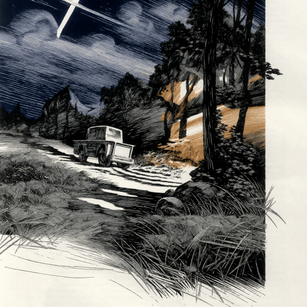
The familiar story begins with a fiery object crossing the sky and apparently coming down in woods near Kecksburg. Later accounts describe an acorn- or bell-shaped metal object, strange markings, military personnel, a guarded search area, and a covered object removed on a truck. In the strongest conspiracy version, the government recovered something extraordinary and concealed it.
Those details do not all have the same evidentiary weight. A widely seen fireball and reports of official activity are one category. The shape, markings, recovery, and identity of an object depend on recollection and later reporting, with important differences between witnesses.
Earliest credible accounts
The earliest local coverage located for this review is the December 10, 1965 Greensburg Tribune-Review. NASA’s released Kecksburg bibliography identifies two same-day editions with notably different headlines: the early county edition reported “Unidentified Flying Object Falls Near Kecksburg,” while the city edition reported “Searchers Fail to Find ‘Object.’” That contradiction was present from the first morning, before decades of documentaries and retrospective interviews.
Contemporary reports also document a bright phenomenon seen over a broad region on December 9. They do not confirm recovery of an extraterrestrial craft. Project Blue Book was the Air Force program then responsible for investigating UFO reports, and the National Archives preserves its case and administrative files. “Unidentified” means the available information did not yield a conclusion; it is not a synonym for alien spacecraft.
Documented historical context
The 1960s combined intense public attention to spaceflight, Cold War secrecy, satellite reentries, missile development, and flying-object reports. That setting made both ordinary uncertainty and suspicion of official statements understandable. It also means proposed explanations must be tested against dates, trajectories, records, and witness evidence rather than chosen for dramatic appeal.
NASA later assembled and released records and a bibliography in response to requests concerning Kecksburg. The existence of a government file trail shows sustained public inquiry, not government confirmation of a nonhuman craft. National Archives access to Project Blue Book likewise permits research into official handling while leaving particular disputed claims open to interpretation.
Conflicting versions
Explanations have included a meteor or bolide, reentering space hardware, and an unidentified manufactured object. The Soviet probe Cosmos 96 is often mentioned, but timing and trajectory arguments have been used both for and against that identification. Witness accounts also disagree over whether anything landed, what military personnel found, and whether a large object left the area.
Later retellings sometimes combine details recorded at different times into a single seamless narrative. Memory can remain sincere while changing, especially after decades of interviews and media coverage. That does not justify dismissing witnesses, but it does require distinguishing contemporary documentation from later reconstruction.
What remains unverified
Publicly available records do not conclusively establish the object’s identity. They also do not verify extraterrestrial origin, unusual writing, a secret recovered craft, or a complete government cover-up. The gap between “not conclusively explained here” and “therefore alien” is exactly where legend grows.
How the fiction adapts the material
Chapter 7, “Do Not Answer the Radio,” transforms the Kecksburg mystery into supernatural suspense. Its young characters, radio messages, danger, and resolution are invented. The story uses uncertainty as creative material; it does not claim to solve the 1965 incident.
Sources
- U.S. National Archives: Project Blue Book, program history, official conclusions, and access information.
- U.S. National Archives: UAP records bulk downloads, including digitized Project Blue Book record groups.
- NASA FOIA release concerning Kecksburg, a collection and bibliography that identifies the December 10, 1965 county- and city-edition Tribune-Review reports.