Clinton County family folklore
The Giwoggle of Clinton County
A wolf-bodied, claw-footed monster said to have been made by a witch sounds like a modern cryptid. Its clearest written source is instead a 1963 folklore-journal article preserving stories George E. Rhone learned from his grandmother, Belle Confer.
Place-name caution
The collected tradition belongs to West Keating Township in Clinton County. It should not be relocated to similarly named Keating Township in McKean County simply because later summaries shorten the setting to “Keating.”
What the legend says
The Giwoggle combines mismatched animal parts: an upright wolf-like body, bird claws, and horse hooves in common retellings. A witch creates or commands it to trouble farmers. The stories include pursuit, tracks, livestock anxiety, and the backwoods character Loop Hill Ike, identified as Isaac Gaines.
Unlike a single eyewitness report, the Giwoggle comes to us as a cycle of family stories. Its impossible anatomy and witch-made origin place it comfortably among tall tales and supernatural folk narratives, where exaggeration and comic terror can coexist.
Earliest credible accounts
The primary located written source is George E. Rhone’s “The Giwoggle,” published in volume 8, number 1 of Keystone Folklore Quarterly in spring 1963. Rhone attributed the stories to his grandmother Belle Confer, whose family tradition located them in the West Keating Township area and set their action in the nineteenth century.
That distinction prevents a common dating error. The tales may preserve older oral material and are set in the 1870s, but the reviewed documentary record is a 1963 publication recalling family storytelling. A story’s setting is not automatically the date when the story originated.
Documented historical context
West Keating Township, Clinton County, is a sparsely settled forest landscape shaped by logging, hunting, isolated roads, and small communities. Such places generated many lumberwoods creatures and backwoods tales. Rhone’s publication places one family’s Giwoggle stories within Pennsylvania folklore scholarship rather than presenting a biological report.
Clinton County proclaimed the Giwoggle its official monster on July 21, 2011. The designation recognizes local heritage and a distinctive story. A 2011 proclamation is not proof that the creature exists, just as a festival or mascot is not zoological classification.
Conflicting versions
Later summaries alter the creature’s exact anatomy, height, powers, and relationship to the witch. Some merge it with early-twentieth-century “Jersey Devil” scares or treat any strange regional footprint as Giwoggle evidence. Those associations are later interpretive layers, not part of every version preserved by Rhone.
The geography can also drift. “Keating” may refer to the fictional chapter setting, West Keating Township, or another Pennsylvania place with a similar name. The documented folklore source points specifically to the West Keating area of Clinton County.
What remains unverified
No reviewed source verifies a physical Giwoggle, witch-created animal, or unexplained track attributable to such a creature. The precise age of Belle Confer’s oral material is also unknown. What can be verified is the family attribution, the 1963 journal publication, the Clinton County setting, and the modern county proclamation.
How the fiction adapts the material
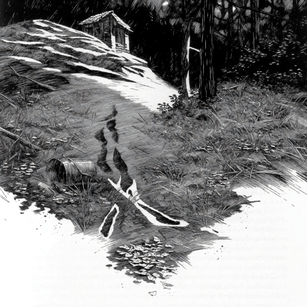
Chapter 10, “The Tracks Around the House,” takes the Giwoggle’s hybrid menace and the isolation of a place called Keating, then invents a creature that copies voices and faces, its child characters, tracks, pursuit, and family crisis. The book’s events are fiction. Its shortened setting should not replace the real tradition’s connection to West Keating Township in Clinton County.
Sources
- PA Wilds, “Giwoggle: Clinton County’s Monster”, regional history of the family story and 2011 proclamation.
- Appalachian Historian, “The Giwoggle of Clinton County”, a detailed source trail to Rhone and Confer.
- HathiTrust catalog record for Keystone Folklore Quarterly, the journal containing Rhone’s 1963 article.
- University of Pennsylvania serial index for Keystone Folklore Quarterly, an issue-level research gateway.