Pennsylvania history and folklore companion
Gettysburg Battlefield Ghost Stories
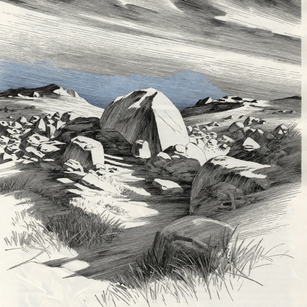
Gettysburg and Devil’s Den, Pennsylvania
Phantom soldiers, distant gunfire, and figures caught in photographs are now part of Gettysburg’s popular image. The battlefield’s documented history is immense; the dates and origins of many ghost tales are much harder to pin down.
Evidence labels used here
Documented history covers the battle, landscape, and archival photographs. Reported folklore records apparition stories without treating them as proof. The National Park Service preserves Gettysburg as a place of commemoration, not as a paranormal attraction.
What the legend says
Gettysburg ghost stories describe soldiers walking ridges, formations crossing roads, unexplained cannon or musket fire, and uniformed figures who vanish when approached. Devil’s Den, the Triangular Field, Little Round Top, the Wheatfield, and sites used as field hospitals all collect their own versions. In modern tellings, a blurred photograph, a voice on a recording, or a sudden smell of smoke may become evidence of a battlefield presence.
These stories express a powerful response to a landscape where thousands were killed or wounded. They also change as they move through tours, books, television, social media, and personal recollection. A sincere experience is still a report by a witness; without corroborating evidence, it is not a documented encounter with a Civil War soldier.
Earliest credible accounts
Unlike the battle itself, many familiar Gettysburg ghost stories do not lead cleanly back to 1863. The American Battlefield Trust notes that, apart from a story associated with Iverson’s Pits, substantially disseminated Gettysburg ghost stories were scarce for more than a century and expanded sharply with commercial ghost books and tours in the 1990s. That assessment does not prove no one told a ghost story earlier; it warns against giving a modern tale an invented nineteenth-century pedigree.
The National Park Service now interprets the subject directly. A 2025 ranger program described phantom regiments, haunted inns, and spectral horsemen while promising to separate history, fiction, and the reasons such stories persist. An official program confirms that the folklore exists and deserves interpretation. It does not certify the apparitions as historical events.
Documented historical context
The Battle of Gettysburg was fought July 1–3, 1863. Devil’s Den saw heavy fighting on July 2, and its boulders quickly became one of the battlefield’s recognizable landscapes. Soon after the battle, photographers Alexander Gardner and Timothy O’Sullivan made images of Confederate dead in and around the rocks.
One of the most famous photographs was constructed rather than discovered exactly as shown. National Park Service and Library of Congress comparisons demonstrate that photographers moved a dead Confederate soldier roughly forty yards from the likely place of death to a rocky position, added a rifle, and photographed the body as a “sharpshooter.” The rifle was not the kind a sharpshooter would likely have used, and the soldier’s identity remains uncertain.
The documented moved body is not a ghost story, but it explains why photography is such potent material for Gettysburg fiction. A photograph can preserve real evidence while also framing, staging, and misidentifying it. That tension—between what the camera records and the story attached to the image—has lasted far longer than the exposure itself.
Conflicting versions
Apparition accounts disagree about uniform color, location, time, behavior, and whether a figure is visible to the eye or only in a photograph. The same unexplained sound may be called a reenactment, distant traffic, weather, memory, or musket fire from the past. “Orbs” in photographs may be interpreted as spirits by one viewer and moisture, dust, insects, or lens effects by another.
Historical photographs have conflicts of their own. Captions once offered identities that later research challenged. Place names such as Devil’s Den and the Slaughter Pen were sometimes used loosely, complicating attempts to locate an image. Careful comparison of terrain, camera angles, and surviving rocks has corrected parts of the record without identifying every dead soldier.
What remains unverified
No source reviewed here verifies that a battlefield apparition is the spirit of a particular soldier, that a camera captured a supernatural figure, or that unexplained sounds reproduce a moment from the battle. Many popular stories lack a traceable first account. Absence of a source is not proof that a witness is dishonest; it means the claim cannot be presented as established history.
The identity of the soldier in Gardner’s famous sharpshooter image also remains unsettled. The Library of Congress notes that an identification attached to the photograph was challenged because the named soldier’s regiment did not fight near Devil’s Den. “Unknown” is the accurate label when the record does not support a name.
How the fiction adapts the material
Chapter 3 of Hometown Horror Stories: Pennsylvania, “The Soldier Who Wasn’t There,” is fiction set at Devil’s Den. It uses the documented moved-body photograph as a starting point and invents a cracked glass plate, young visitors, battlefield visions, a faceless soldier, and a supernatural threat that can pull someone into an image.
The story’s central question—what happens when an unknown person is replaced by a convenient caption—grows from real problems in historical photography. Its ghost and danger are inventions, not claims about an identified Gettysburg casualty or a documented haunting.
Sources
- Gettysburg National Military Park: “Devil’s Den Then and Now”, comparing the historic photographs with their locations and explaining the moved-body sequence.
- Library of Congress: “The Case of the Moved Body”, an archival comparison of the Devil’s Den photographs.
- Library of Congress catalog record: “Dead Confederate sharpshooter in ‘the devil’s den’”, including the disputed identification note.
- Gettysburg National Military Park: “Shadows of the Past” ranger program, an official description of interpreting the origins and persistence of Gettysburg haunting tales.
- American Battlefield Trust: “7 Gettysburg Myths and Misconceptions”, discussing the comparatively recent spread of many commercial ghost stories.